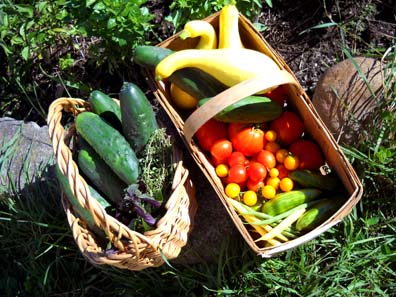
Summer
is one of our favorite times of the year, and having a
garden is a special celebration. Each year we plant a
large garden and enjoy a bountiful harvest of fresh
vegetables, the ultimate in live food! Truly there is
nothing like 'home-grown': you plant it, nurture it,
harvest it, and eat it! Gardening is a healthy, healing
experience that is well worth the effort.
Though our growing season in Maine
is short, we make the most of it by planting as early as
possible. Usually by the end of May we begin to plant. We
till our ground and use mulch around our crops to keep
moisture in and the weeds down. We compost our kitchen
scraps and add the rich, new soil to our garden bed each
year. Rich soil, proper crop rotation, and high quality,
organic seeds determine the level of your garden's
productivity.
We maintain a vegan, organic garden
in that we use no chemical fertilizers or fertilizers and
no animal waste. The only fertilizer we use is MIRACLE II
AGRICULTURAL BLEND which can be purchased by contacting
us. Click here
for more information. We have
found that in using MiracleII Agricultural Blend, our
plants are stronger, more disease resistant, and have a
higher, more extended yield.
Other handy resources we use are
Fedco Seeds www.fedcoseeds.com , and
Johnny's Select Seeds www.johnnyseeds.com. Both are
local companies. Fedco is located in Clinton, Maine,
while Johnny's Select Seeds is just down the road from us
in Winslow. Both of these seed companies have excellent
quality seeds as well as natural pesticides and other
garden-related items.
From time to time, we post garden
information and tips in an effort to help you in your
garden experience.
If we can be of any help to you, let us know. We are glad
to share knowledge that we have gained along the way.
Happy gardening!
In observance of YHVH's command to rest the
land in the seventh year, we rest our garden every seven
years.
|

Plums
clustered on our trees...a plentiful harvest this
year!
Click here to see more
photos from our garden
2008
GARDEN REPORT:
Thanks
to an early wave of warm weather, our garden season
enjoyed an early start in late April this year.
Usually we have a friend rototill, but I decided to
forego tilling in order to get a head start on
planting. It seemed like a good tactic, since many
grower friends are say that tilling disturbs the
soil-based organisms. I decided that I would see
what, if any, difference we experienced by not
tilling this year.
As it
so happened, after planting, the cold, spring rains
came. These rains have become part of our Maine
weather pattern for about four years. Prior to this
time, our springs were what most would consider
normal in terms of light rains and gradually warming
temperatures. As these new 'monsoon' rains descend
upon the state, they are accompanied by cooler, if
not COLD, temperatures. Those looking for spring are
thus 'dampened' in their spirits by the torrential
downpours and forced to yet keep the furnace running
or the wood fire burning. In our case, we had to burn
wood until late May. So it was that spring came,
though ever so reluctantly. In the long run, I
believe we earned every inch.
Due to
the weather, the greens I had planted so
enthusiastically germinated sporadically. Hence, I
had the pleasure of replanting them, an exercise that
I consider a chore. Nevertheless, it was a labor of
love since greens are my favorite part of the garden.
I planted a wider assortment of greens this year, all
of which came from FedCo Seeds. I enjoy using their
seeds partly because their selections are numerous,
the company is close by, we know the owner, their
prices are the most reasonable, and most of all,
their catalog is one fantastic read: a real work of
Maine journalistic art. If you have never seen or
read a FedCo seed catalog, give yourself a treat by
signing on. It is both informative and entertaining.
Back to gardening...
Once I
replanted all my greens (varieties of kale, chard,
endive, chickory, lettuce), our seedlings arrived. We
have friend who graciously grows our seedlings for
us. We used to grow our own (in the dining room
window), but the process eventually became
unmanageable. It was soon evident that the dining
room was not meant to be a greenhouse. Thus, we were
happy to farm out the seedlings to someone else. This
year we once again had many trays of plants: several
lettuce, raddichio, herbs, tomatoes, tomatillos,
kohlrabi, broccoli, cauliflower, and Asian greens.
The latter were an added surprise. Researching our
catalogs, I discovered the Asian greens were similar
to broccoli.
After
accomplishing the herculean task of planting all our
seedlings, the rains descended again sometimes on a
daily basis. The weather patterns proved to be like
the semi-tropics. In some ways, it was refreshing;
but in other ways, gardening became difficult.
Weeding was a challenge. However, with the rain
softening the soil, I was able to weed at record
speed between rain showers. Then I put down straw
mulch to keep in the moisture and discourage the
growth of more weeds. I chugged along to accompligh
my mulching mission, so that I could sit back for
awhile and watch the garden grow.
Well,
grow the garden did, however slowly. The beets were
stubborn and did not want to germinate. The heavy
rains were no doubt responsible. So, I ended up
replanting the beets a few times. When I thought I
had the beets under control, I realized that the flea
beatles were taking their toll on the kale, arugula,
and collards. I was not happy. Though I used row
covers to discourage, if not prevent, such an
infestation, the tactic did not work. For the most
part, the arugula was as good as ruined and the
collards were bearly hanging on. I replanted, hoping
for the best; but as of this writing, only a sparse
few collards survived and the arugula was a wipe out.
Though these losses were a disappointment, I am at
least happy to have some collards as evidence that I
tried!
As our
garden matured, my greatest dismay set in: ugly,
giant weeds were surfacing through the straw mulch. I
was devastated. All my hard work and best intentions
were dashed to pieces. The weeds did not pull out
easily from the straw. They were tenacious, nasty,
and ugly. I resigned myself to letting them be,
because I had more important work to do in tending
the garden.
It is
now the end of July and the summer is once again
slipping by. Overall, our garden is growing well. The
greens are lush and plentiful. Our kale has survived
its early encounter with flea beatles. I'm glad the
kale won. It's a joy to go out into the garden and
pick our daily meals. It's fun, easy, and doesn't
cost anything. Besides, it's healthy. There are
definite benefits to having a garden...
If I
were to score our garden for this year, this is the
assessment I would presently make:
| Pluses: |
|
Minuses: |
| |
|
|
1) New
varieties of kale grew well
2) I was able to grow endive and chickory!
3) Our raddiccio is gorgeous!
4) We have more blackberries and raspberries
than ever
5) Our herbs are HUGE
6) Our St. John's Wort has been blooming
profusely for over a month
(great for making a medicinal oil)
7) Few slugs considering the amount of
rainfall
|
|
1) No
arugula (my favorite)
2) Only a few collards
3) Disasterous weeds, seeds of which
most likely arrived in the straw ( I have
registered a complaint with the supplier)
4) The upper garden appears to be a wipe out,
due to the salt/calcium chlorate used by the
town in its winter road maintenance. This
loss accounts for about 1/3 of our garden.
5) Two ground hogs, but trapped (thankfully)
6) Too few flowers. Our zinnas bowed out
early in the season. I don't know why, but I
miss their smiling faces.
|
As
the season continues, we invite you to stay tuned.
There are signs of tomatoes on the vines and the
tomatillos are displaying their little
'japanese-type' lanterns. Soon there will be fruit to
pick. We can't wait, but we must. In the meantime, we
are busily eating...and eating well!
Click here to see more
photos from our garden
|